Introduction
Meet Arun — and the people who taught him what quality really means.
Welcome
Every app you have ever loved — and every app that has ever let you down — was shaped by an invisible craft called software testing. This is a story about that craft, told through the life of one engineer who began by getting it completely wrong.
From Bugs to Brilliance follows Arun across the most important years of his career: from a confident young developer who breaks a bank's login for forty-one thousand people, to a quality leader who learns to work side by side with thinking machines.
Each chapter hides a real testing idea inside a very human story — no jargon, no lectures. Just one person slowly learning to see software the way the best testers do: not as screens, but as promises made to strangers.
You can read it like a book, or press Listen on any chapter to hear it read aloud.
The people you'll meet
A handful of people shape Arun's journey. You'll meet them again and again.
Arun — the hero of our story. A bright, slightly over-confident new graduate who learns, the hard way, that making software work and making it safe are two very different things.
Meera — a calm, sharp senior tester, and the mentor Arun never expected. She rarely hands him answers. Instead she asks the one question nobody else in the room thought to ask.
Priya — a senior manager who believes quality is everyone's job, and isn't afraid to say so in a room full of proud engineers.
Rohan — a talented, doubting developer who thinks testing is beneath him. His scorn keeps pushing Arun to think harder than he wants to.
Their story runs from the very first ideas of testing all the way to the age of artificial intelligence. Turn the page, and start where Arun started — on his first day.
This book is a work of fiction. The names, characters, companies, places, and events are either products of the author's imagination or used in a fictitious way. Any resemblance to actual people — living or dead — real companies, or real events is entirely coincidental. The incidents and "bugs" are illustrations created to teach ideas about software testing, not accounts of any real project.
The Day Everything Changed
Where Arun learns that "it works on my machine" is not the same as "it works."
Page 1 · First day
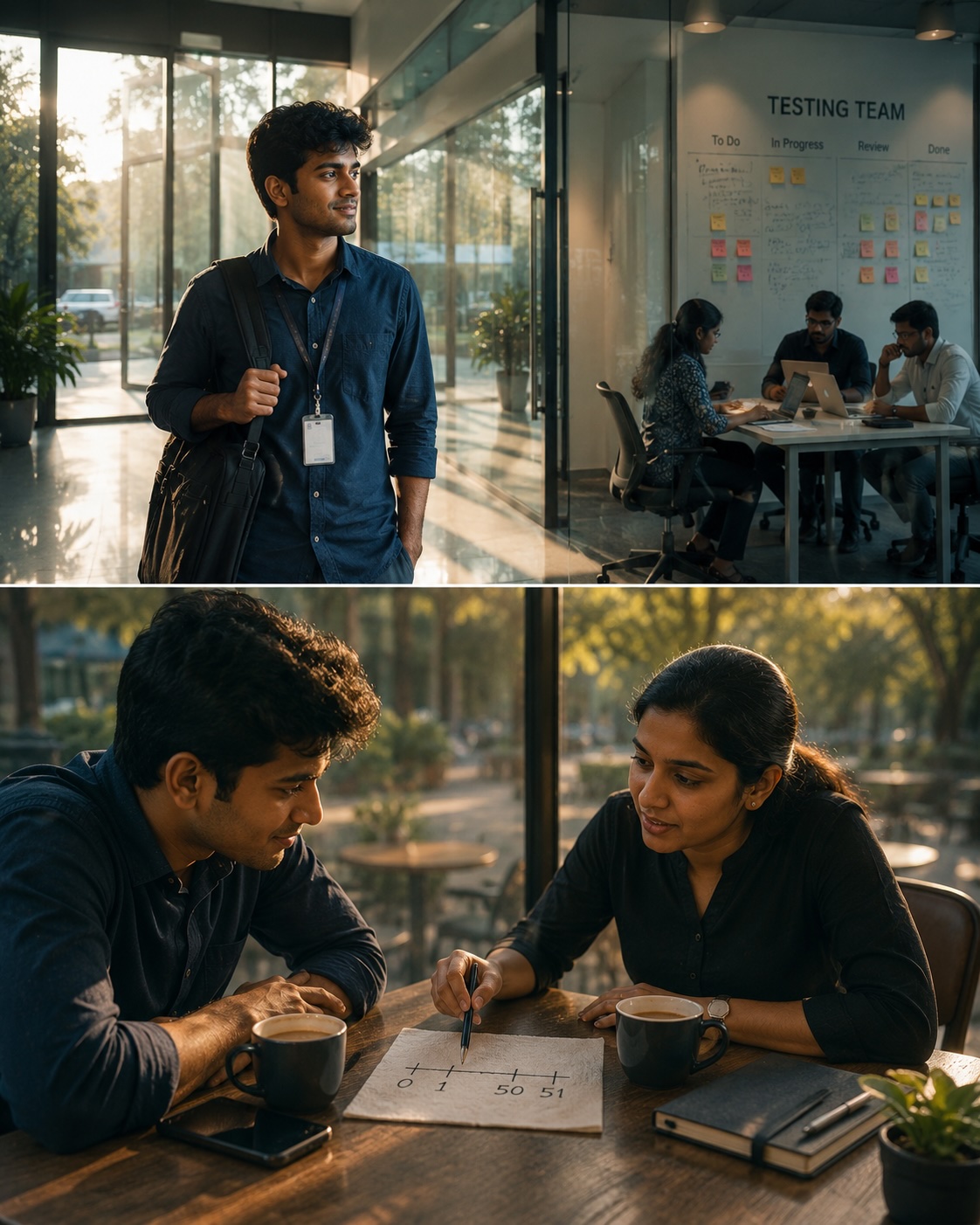
Rain tapped on the glass walls of TechNova Solutions. Arun stood in reception, holding a laptop bag that still smelled new. It was his first day as a software engineer. Six years of study. Eleven rejected job applications. Three rounds of interviews. And now a badge with his photo on it.
Through the glass he watched people work. Developers argued at a whiteboard. A manager carried three coffees. In one corner, a few people clicked through screens with quiet focus.
"Who are they?" he asked the receptionist.
"The testing team."
Arun felt a small, private relief. Thank goodness I'm a developer, he thought. Imagine clicking buttons all day. He would remember that thought for a long time.
Page 2 · Induction
The training session was the usual blur of slides — until a senior manager named Priya picked up a marker and wrote four words on the board:
"Quality is everyone's responsibility."
Arun raised his hand. "Isn't quality the testing team's job? That's why they exist, right?"
Priya didn't smile. "Last year a bank app sent payment alerts to the wrong people. Did any customer ask which team broke it? No. They only knew the app failed them. The name on the app takes the blame. And that name belongs to all of us."
Arun wrote the four words in his new notebook, mostly to look keen. Years later, he would write the same four words on a board himself, in front of a hundred engineers.
Page 3 · The simple task
Three weeks in, Arun got his first real ticket.
He almost laughed. This was the job he fought eleven rejections for? He changed one setting, updated one line of checking on the screen, and tried it on his laptop. A 45-character username worked. His own worked. Code review: approved in nine minutes. The change went live on Friday evening.
That night he told his parents the job was going great. He said — and would later wish he hadn't — "Honestly, it's easier than university."
Page 4 · The war room
At 2:17 AM on Saturday, a screen in a data centre quietly turned red. By Monday, the war room held more people than Arun's whole graduation class.
For an hour, every team explained why it wasn't their fault. Then a calm voice from the back row cut through. A senior tester named Meera asked the simplest question in the room:
"The screen blocks long usernames. But corporate clients log in through the API — the direct doorway into the system, with no screen in front of it. What does the API do at fifty-one characters?"
Nobody knew. Eleven minutes later, everybody did: the API had no length check at all. One missing line had locked 41,000 people out of their bank.
Page 5 · Coffee with Meera
Arun spent the day waiting to be fired. Instead, at 4 PM, Meera appeared with two coffees. "Walk with me."
"I know why this happened," he said, staring at the table. "I wrote bad code."
Meera shook her head. "No. Your code did exactly what you told it to do. That's the sad truth about code — it always does." She slid a coffee across. "Here's what really happened. You tested that your change worked. You never tested how it could fail. Those are two different jobs, and only one of them protects customers."
"But it worked on my machine—"
"It always works on your machine," she said. "Your machine is the kindest user your software will ever meet. Real users are messy. Real attackers send fifty-one characters on purpose."
"So what is testing, really?" Arun asked. "Clicking the app until something breaks?"
"Close, but bigger than that," Meera said. "Software testing is checking that software does what it should — and finding where it doesn't — before real users do. We take every promise the software makes and ask one question: what if this isn't true? Then we go looking for the answer."
Page 6 · How testers think
The next morning, Meera drew a line on the whiteboard. "Your username field accepts 1 to 50 characters. You get five tests. Where do you spend them?"
Arun wanted to redeem himself. "Twenty-five? Right in the middle?"
Meera smiled. "That's where everyone starts. But nothing interesting ever happens in the middle. Bugs live at the edges." She marked four points. This is boundary testing — checking the values right at the limits, where mistakes hide.
The middle almost never fails. The edges almost always do.
"Positive testing proves it works with good input," she said. "Negative testing proves it fails safely with bad input. Boundary testing tells you where to look. Three simple ideas. They find more bugs than any tool you can buy."
Page 7 · Breaking things on purpose
That afternoon, Arun did something he had never done: he tried to break software on purpose. The team had just finished a new sign-up form. Developer-tested. Peer-reviewed. Ready to ship. Arun filled it in like a problem waiting to happen.
An email with no "@" symbol? Accepted. Bug one. A company name the length of a short story? The page froze, then crashed. Bug two. Date of birth: 30th February — a date that does not exist? The form said "Welcome!" Bug three.
One hour. Three bugs. In a feature that had already "passed" testing. It didn't feel like clicking buttons. It felt like being a detective in a building where every door might be unlocked.
Page 8 · Curiosity becomes a habit
Weeks passed, and curiosity stopped being an exercise and became a reflex. Arun's notebook filled with questions:
He began to see software the way Meera did — not as screens, but as promises. Every field was a promise to a stranger. Testing was simply checking whether the promises held when life got messy.
Rohan, a senior developer, passed by and smirked. "Careful, Arun. Hang around testers too long and people will think you're one of them." It was meant as a warning. To his own surprise, it didn't sting at all.
Page 9 · The folder
One Friday evening, Meera dropped a paper folder on his desk. She was old-school like that. "Ready for your next challenge?"
Inside was a single printed email. A serious live bug. A customer charged twice for nothing. Words Arun had heard but never really understood: API. Endpoint. JSON. Race condition.
"I don't know what half of this means," he admitted.
"I know," Meera said, already walking away. "That's exactly why it's yours. Monday, I show you the part of the iceberg under the water — the bugs nobody can see, and everybody pays for."
Page 10 · Key lessons
Quality is everyone's responsibility. The product takes the blame, and the product belongs to the whole team.
Test how software fails, not only that it works. "It works on my machine" means it survived the kindest user it will ever meet.
Bugs live at the edges. Boundary testing checks 0, 1, 50 and 51 — not the safe middle.
Positive testing proves it works; negative testing proves it fails safely.
Curiosity is a tester's superpower. Tools can be learned; never growing out of "what if?" cannot.
The Invisible Layer
Arun goes below the screen — into APIs, JSON and logs — to hunt a bug that charged a customer £4,820 for nothing. The only witness is a log file with a timestamp.
The Invisible Layer
Where Arun learns that the worst bugs are the ones no screen will ever show you.
Page 1 · Below the line
The folder held one printed email. Arun read it three times.
"But I tested the checkout last week," Arun said. "The button works. The confirmation screen appears. Everything looks fine."
"That's the problem," said Meera. "You tested everything you can see. This bug lives somewhere you've never looked." She drew two lines in his notebook. "Above the line is the screen — buttons and forms. Below the line is where the real work happens — APIs, services, databases. Today, you go below."
Page 2 · Talking to the API
Meera opened a tool Arun had never used: Postman — a tool that lets you send requests straight to an API, with no screen in the way.
"The browser is just a polite messenger," she said. "When you click 'Pay Now', the browser sends a request to a payment API. The API does the work and sends back a response. We'll talk to the API directly — no browser, no buttons."
She hit Send. Text appeared, wrapped in curly braces. This is JSON — a simple way for computers to send data as labelled values.
Arun stared. "Payment taken… but order created is false? How can both be true at once?"
Meera smiled the way she always did before a lesson. "Now that is the right question."
Page 3 · Two steps, not one
She explained that checkout was not one action but two: first take the payment, then create the order. Two different services. Two different teams.
"What happens," she asked, "if the first step works and the second one fails?"
Arun thought. "The customer pays… for nothing."
"Exactly. The screen showed a friendly message — 'Something went wrong, please try again.' So the customer tried again. Paid again. Two payments. Zero orders. The screen looked fine both times. The bug was invisible." This is an integration bug — each part works alone, but they fail when they work together.
Page 4 · Windows, not doors
For two hours, Arun fired requests at the payment API like a detective questioning a suspect.
What if the amount is zero? Rejected — good. What if the amount is negative? He blinked at the screen. Accepted.
"Meera. The API just accepted a payment of minus five hundred pounds."
She looked, and laughed. "You just found a bug where the bank could pay the customer. The screen blocks negative numbers. The API doesn't. And attackers don't use the screen." That sentence stuck in Arun's head forever:
Page 5 · The bug that wouldn't appear
But the double-charge mystery remained. Arun repeated the customer's exact steps in Postman. Payment — success. Order — success. Again. Success. Again. Success.
"It works every time," he groaned. "How do I find a bug that won't happen?"
Meera leaned on the desk. "When a bug won't show itself, stop asking what went wrong. Ask when. What was different at the moment it failed?"
Arun opened the logs — the diary a system writes about everything it does, each line stamped with the exact time. He scrolled to the second of the customer's payment.
He stared at the two timestamps. Then he saw it.
Page 6 · Midnight
The order service restarted every night at midnight for maintenance. For thirty seconds, it was deaf to the world. The customer had clicked "Pay Now" two seconds before midnight. The payment went through at 23:59:58. The order request arrived at 00:00:01 — into a service that wasn't listening.
"It's not a code bug at all," Arun said slowly. "It's a timing bug. The system has a thirty-second blind spot every night, and nobody tests at midnight." When the result depends on the exact timing of two things, testers call it a race condition — two events racing, and sometimes the wrong one wins.
To prove it, he scheduled a test payment for 23:59:59, went home, and barely slept. At 00:00:04 his phone buzzed: PAYMENT_TAKEN, order not created. Caught red-handed. In an empty office at midnight, a bug had finally met a tester willing to stay up for it.
Page 7 · The retro
The fix took the developers twenty minutes: if the order step fails, refund the payment automatically and tell the customer the truth. The harder part was the meeting afterwards — the retrospective, where the team looks back and asks how to do better.
"Why didn't testing catch this before release?" asked Rohan, arms crossed.
The old Arun would have stayed quiet. The new one didn't. "Because we only tested that checkout works. Nobody asked how it could fail. I've written eleven failure questions for checkout — what if payment works but the order doesn't, what if the same request arrives twice, what if a service is restarting. I want these in every release."
The room went quiet. Then the manager said: "Send that list to everyone. That's not a testing checklist. That's how we should all think."
Page 8 · An offer
That evening, Meera found him still writing failure questions. "You know what you did today? You didn't just find a bug. You changed how a room full of engineers thinks. That part isn't in any job description."
She paused at the door. "There's an opening on the quality engineering team. Interviews next month." She let it hang. "You'd have to stop calling yourself a developer."
"What would I tell my parents?" he half-joked. "They think testing is what people do when they can't code."
Meera laughed. "Tell them you've been promoted — from building things to protecting everyone who uses them."
Page 9 · The parking meter
He didn't say yes that night. Real decisions don't work that way.
But on Saturday, on his usual walk, Arun stopped at a parking meter and caught himself thinking: What happens if I pay at the exact moment it loses signal? Does it take my money? Where does that payment go?
He stood there for a full minute, smiling at a parking meter like a fool. That's when he knew. It wasn't a job change. It had already happened — somewhere between a 2 AM outage and a midnight stakeout. The title was just paperwork. On Monday, he applied.
Page 10 · Key lessons
The screen is only the surface. The most costly bugs live below it, in APIs and services.
The screen is the front door; attackers come through the windows. Test the API directly.
When a bug won't reproduce, ask when it happened, not just what happened.
Logs and timestamps are a tester's crime-scene evidence.
A great tester doesn't just find bugs — they change how the whole team thinks about failure.
The Nine-Day Test
Arun joins the quality team and meets the monster: 400 tests, run by hand, taking nine days — for a release due every two weeks. A manager asks the question that starts a new era: "Why is a human doing any of this?"
The Nine-Day Test
Where Arun meets a job so slow and dull that a machine had to be the answer.
Page 1 · The new desk
Arun got the job. On his first day with the quality team, Meera showed him a thick binder. "Meet the release checklist," she said. Inside were 400 test cases — 400 separate checks a person had to do by hand before every release.
"How long does this take?" he asked.
Meera didn't blink. "Nine days. Two testers. Clicking, typing, comparing — by hand."
Arun laughed, then realised she wasn't joking.
Page 2 · The boring half of the job
Most of those 400 checks weren't new. They tested old features that already worked. "Why test things that already work?" Arun asked.
"Because new code can break old features without anyone noticing," Meera said. "Re-checking that the old things still work after a change is called regression testing. A bug that sneaks back into something that used to work is a regression."
"So every release, you re-do all 400?" Arun asked.
"Every release. By hand," Meera said. "The same clicks. The same typing. For nine days."
Page 3 · The math doesn't work
Arun did the sums. The company wanted to release every two weeks. The check took nine days. That left almost no time to fix anything they found.
Worse, tired humans make mistakes. By day seven, eyes glaze over. Steps get skipped. Bugs slip through anyway. In the next planning meeting, Priya said the words that started everything: "Why is a human doing any of this?"
Page 4 · Let the computer click
Meera pulled up a chair. "A computer never gets bored and never skips a step. We can write instructions that make it click the buttons, type the values, and check the results for us. That's test automation — a program that runs the checks instead of a person."
She drew two words. "One check is a test case. A group of test cases, run together, is a test suite. Our 400 checks are one big suite — and right now, a human is the one running it."
Page 5 · His first automated test
Meera handed him the simplest case: the login check — the very feature he had broken in his first weeks on the job. Together they wrote it as code: open the page, type a username, type a password, click login, then check that the dashboard appears. That check is called an assertion — the line that says what "pass" actually means.
Three seconds. The check that once took him an hour by hand now ran while he reached for his coffee. Arun felt something click in his chest. "I want to do that to all 400."
Page 6 · Smoke first
"Slow down," Meera said. "You don't automate 400 things on day one. Start with a smoke test — a small, quick set that checks only the most important things still work. Can users log in? Can they pay? If the smoke test fails, stop; the building is on fire."
"And the full 400?" Arun asked.
"That's the full regression suite," Meera said. "You build it up over time — the important things first, the rare things last."
Page 7 · Nine days to nine minutes
Over the next two months, Arun automated case after case. The numbers changed his life: the nine-day check, run by hand, now finished in nine minutes.
The very same checks — the computer just never got tired.
But Meera added a warning he didn't fully hear yet. "Automation isn't free. Every test you write, you also have to maintain. Bad automation can cost you more than no automation at all. Remember that."
Page 8 · Not out of a job
Rohan, of course, had an opinion. "So testers are writing the code that replaces testers. Clever."
Meera didn't rise to it. "No. The computer is brilliant at repeating the same check a thousand times. It is hopeless at asking a question it was never given. Automation does the boring repeats. That frees us to do the thinking — to ask 'what if' about things no one has imagined yet."
Page 9 · A little too proud
For the first time, Arun saw himself differently. He wasn't just a person who ran tests. He could build the machine that ran them. The nine-day monster had become a nine-minute helper, and he had tamed it.
So he did what proud young engineers do. He started automating everything — every screen, every click, as fast as he could type. More tests had to mean more safety. Surely.
Meera watched the pile of new tests grow, and said nothing. Some lessons can only be taught by letting them happen.
Page 10 · Key lessons
Regression testing re-checks that old features still work after a change. By hand, it does not scale.
Automation is a program that runs the checks for you — tireless, fast, and exact.
A test case is one check; a test suite is a group of them. Every test needs an assertion that defines "pass".
Start with a small smoke test of the vital things, then grow the full suite over time.
Automation isn't free — you must maintain it. Its real gift is freeing humans to think.
The Tests That Cried Wolf
Drunk on speed, Arun automates everything in sight. Then his tests start failing for no reason — pass one minute, fail the next — until the team stops believing them. He is about to learn that a test you can't trust is worse than no test at all.
The Tests That Cried Wolf
Where Arun learns that more tests are not better tests — and trust is the only thing that counts.
Page 1 · The cheering stops
At first, Arun's growing pile of automated tests made him a hero. Three hundred tests. Four hundred. A green wall of passes. The team cheered.
Then, one Tuesday, the wall turned red. Forty tests failed. Arun checked in a panic — but the app was fine. He ran the tests again. This time they passed. Nobody had changed a thing.
Page 2 · Pass, fail, pass, fail
It kept happening. The same test would pass, then fail, then pass — with no change to the code or the app.
The team learned to shrug. "It's just flaky. Run it again." A red result stopped meaning danger. It started meaning annoyance.
Page 3 · The word for it
Meera gave it a name. "A test that passes or fails at random, with no real bug behind it, is a flaky test. And flaky tests are dangerous — not because they fail, but because they teach people to ignore failure."
She listed the usual causes: tests that wait a fixed number of seconds and guess wrong, tests that find buttons in a fragile way, and tests that share data and trip over each other.
Page 4 · The wolf arrives
Then it happened. A real bug — a broken payment button — reached production. The automated test had caught it. It had turned red the night before. But the team, trained by months of false alarms, had shrugged and clicked "run again."
Arun felt the floor drop. He had built the boy who cried wolf. When the real wolf came, nobody looked up.
Page 5 · Stop guessing at time
Meera sat with him. "Most of your flakiness is waiting. Your tests pause for a fixed two seconds, then carry on. Some days the page takes three. So the test clicks a button that isn't there yet — and fails."
The fix was the explicit wait: don't wait a guessed number of seconds — wait for the exact thing you need, then continue the instant it's ready. "Never sleep for time," she said. "Wait for a condition."
Page 6 · Point to things that won't move
The next cause was how the tests found buttons. Arun had pointed at fragile positions — "the third button in the second box." When designers moved things, every test broke.
A locator is the address a test uses to find something on the page. "Use stable addresses," Meera said. "Ask the developers for a fixed label on the important elements. Point to that, not to a position that changes every week."
Page 7 · The pyramid he built upside down
Then Meera drew the real problem. "You wrote almost everything as a slow, full-app test through the screen. Those are powerful, but slow and shaky. Look at the shape you should aim for."
This is the test pyramid. Lots of tiny unit tests that check one small piece of code in milliseconds. Fewer integration tests that check parts working together. Only a few slow end-to-end tests through the whole app. "You built an ice-cream cone," Meera said. "All the weight at the top. No wonder it wobbles."
Write lots of fast unit tests to check small pieces of logic, add integration tests for how services work together, and keep only a few end-to-end UI tests for the journeys that matter most.
Page 8 · Tidy the house
Finally, she showed him how to organise the automation itself. Right now, the address of the login button was copied into 200 tests. Change the page, fix 200 places.
The Page Object Model fixes that: keep each screen's details in one file. When the screen changes, you fix it once, and every test that uses it is healed. "Good automation," Meera said, "is mostly good housekeeping."
Page 9 · Less, but trusted
Arun deleted hundreds of his own tests. It hurt. He rebuilt a smaller set: fast, stable, and honest. He also learned what not to automate — things that change every week, rare one-off checks, and anything where a human eye judges better, like whether a page simply looks right.
The green wall was smaller now. But when it turned red, the whole team stood up. He had stopped being a fast coder. He had become a careful engineer.
Page 10 · Key lessons
A flaky test passes or fails at random. Its real damage is teaching people to ignore red.
Never wait a fixed number of seconds. Use explicit waits — wait for the exact thing you need.
Use stable locators (fixed labels), not fragile positions that break when the page moves.
Follow the test pyramid: many fast unit tests, fewer integration tests, few slow end-to-end tests.
Keep each screen's details in one place (Page Object Model). And don't automate everything — some checks belong to humans.
Every Commit, Every Time
Arun's tests are finally solid — but someone still has to remember to run them, and bugs are found days too late. Meera shows him how to make the tests run themselves, on every single change, before anyone even asks.
Every Commit, Every Time
Where the tests stop waiting for a human to remember them.
Page 1 · The forgotten run
The tests were trustworthy now. But a new problem appeared: people forgot to run them. A developer would change some code on Monday, and nobody ran the tests until Thursday. By then the bug was three days old and buried under newer code.
"The tests are good," Arun complained. "They're just always late."
Meera nodded. "So stop relying on memory. Let's make the tests run themselves."
Page 2 · A robot that never forgets
She introduced Continuous Integration, or CI: a system that automatically runs your tests every single time someone changes the code. No human has to remember. No one can skip it.
"Every time a developer saves their work to the shared code — a commit — the robot wakes up, builds the app, and runs the tests. Within minutes, it tells everyone: green or red."
Page 3 · The pipeline
Arun set up the steps. Together they form a pipeline — an assembly line for code.
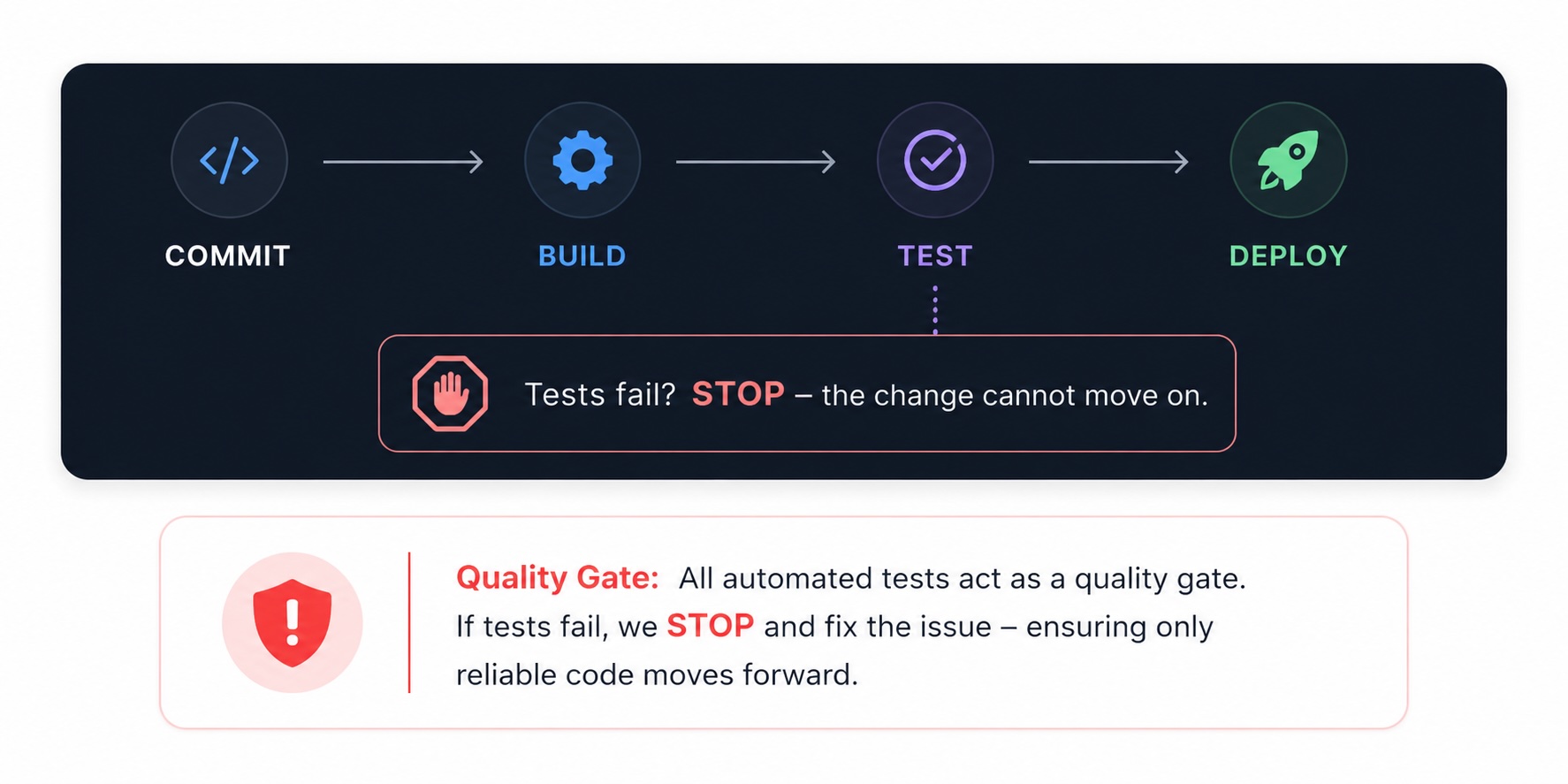
If any test failed, the pipeline stopped. The broken change could not move forward. This is a quality gate — a checkpoint that bad code cannot pass.
Page 4 · Catch it the same day
Something changed in the team's rhythm. A developer would make a change at 10 AM and, by 10:09, the robot would say a test had failed. The bug was nine minutes old, not three days. It was still fresh in the developer's mind. The fix took two minutes.
Testing early, right beside the coding, has a name: shift-left — move testing to the left, toward the start, instead of saving it all for the end.
Page 5 · Too slow to be useful
There was one snag. As the suite grew, the pipeline took 40 minutes. Developers hated waiting. Slow feedback is almost as bad as no feedback.
"Split the work," Meera said. Instead of running tests one after another, run many at the same time on several machines. This is parallel running. The 40-minute run dropped to 8. "Fast feedback is the whole point. A test result nobody waits for is a test nobody reads."
Page 6 · Not on your laptop
Arun also learned where tests should run. Not on his laptop, where the settings were special and the data was his own. They needed an environment — a clean, separate copy of the system set up to look like the real thing.
And tests needed their own test data — fake users and orders, created fresh and cleaned up after. "Never test against real customer data," Meera warned. "And never let one test leave a mess that trips up the next."
Page 7 · The wall that protects everyone
One afternoon, Rohan pushed a risky change minutes before going home. The old days, it would have slipped out and broken on Saturday. Now the pipeline caught it, turned red, and politely refused to let it through.
Rohan grumbled. Then he fixed it before dinner. Quietly, he started running the tests himself before committing. The gate hadn't just caught a bug. It had changed a developer's habit.
Page 8 · Invisible, and powerful
Arun noticed something strange about his new role. When everything worked, no one thanked him. The pipeline just hummed in the background, catching mistakes before customers ever saw them.
He used to want to be the hero who found the big bug. Now he was building a system that quietly stopped big bugs from being born. It was less glamorous. It was far more powerful.
Page 9 · Built in, not bolted on
Priya's four words came back to him: Quality is everyone's responsibility. He finally understood them. Quality wasn't a person standing at the end of the line, catching mistakes. It was something built into every step of how the team worked.
The nine-day human checklist was now a nine-minute robot that ran on every change, all day, forever. Arun had not just automated tests. He had automated trust.
Page 10 · Key lessons
Continuous Integration (CI) runs your tests automatically on every code change — no human has to remember.
A pipeline (build → test → deploy) with a quality gate stops broken code from moving forward.
Shift-left: test the same day you code. Early bugs are cheap; late bugs are expensive.
Keep feedback fast — run tests in parallel. A slow result is one nobody waits for.
Test in a clean environment with its own test data, never on a laptop or against real customers.
When "It Works" Isn't Enough
A new feature passes every single test — then falls over on the biggest sale day of the year. Arun discovers that working software and good software are not the same thing.
When "It Works" Isn't Enough
Where Arun learns that a feature can pass every test and still fail every customer.
Page 1 · Green, and still broken
The new checkout feature was perfect. Every test passed. The pipeline was a wall of green. Arun signed it off with pride. Then came the winter sale.
At 9 AM, thousands of shoppers arrived at once. By 9:04, the site slowed to a crawl. By 9:11, it fell over completely. No error in the code. No failing test. The feature worked — it just couldn't survive a crowd.
Page 2 · Two kinds of question
Meera drew a line down the whiteboard. "Every test you've written so far asks one question: does the feature work? That's functional testing. But there's a second question, and you never asked it: does it work well? That's non-functional testing."
The first kept passing. The second was never asked.
Page 3 · Testing the crowd
"Your checkout works for one user," Meera said. "Did anyone test it with ten thousand at once?" That is performance testing — checking that software stays fast and stable under real-world load.
She named the family: a load test checks a normal busy day; a stress test pushes until it breaks, to learn where the ceiling is. "You don't want to discover your ceiling during a sale. You want to discover it on a Tuesday, on purpose."
Page 4 · Ten thousand fake shoppers
Arun built a test that pretended to be 10,000 shoppers. The numbers told the story.
The trouble was one slow database query, fine for one user, deadly for ten thousand. Fixing it let the system grow smoothly with the crowd — its ability to do that is called scalability.
Page 5 · The windows, again
Then Meera asked a colder question. "Your checkout takes money. Have you tested it against people who want to steal?" That is security testing.
Arun remembered the negative payment he'd uncovered months earlier — that had been a security bug too. Meera showed him another: typing sneaky commands into a form to trick the system, an attack called injection. "Rule one of security," she said. "Never trust anything a user sends you. The screen is the front door. Attackers still come through the windows."
Page 6 · Software for everyone
The next lesson surprised him most. Meera turned off her mouse and used the site with only the keyboard. She couldn't finish checkout — a key button could not be reached. Then she switched on a screen reader, the software a blind person uses to hear the page aloud. It read a button as "button, button, button." Useless.
This is accessibility — making sure software works for people with disabilities. "Some of your users can't see the screen, or can't use a mouse," Meera said. "Leaving them out isn't just poor quality. In many countries, it's against the law."
Page 7 · What if a part dies?
One more question. "What happens when something your app depends on stops responding — a payment provider, a database?" That is reliability: staying usable even when a piece breaks.
They tested it by switching off a service on purpose. The app didn't just slow down — it showed customers a frightening error and lost their basket. They fixed it to fail gently: keep the basket, show a calm message, try again. "Things will break," Meera said. "Good software breaks politely."
Page 8 · The many rooms of quality
Arun wrote them all in his notebook. Speed. Scale. Security. Accessibility. Reliability. Together, testers call these the quality attributes — all the ways software must be good, beyond simply working.
Page 9 · Humbled, again
He had felt like an expert. The sale-day crash reminded him he had only been testing one room of a very large house. There were whole floors he had never entered.
It didn't discourage him. It did the opposite. Three years ago he thought testers clicked buttons. Now he knew the field was deep enough to spend a career in — and he wanted to.
Page 10 · Key lessons
Functional testing asks "does it work?" Non-functional testing asks "does it work well?"
Performance testing (load and stress) checks that software stays fast and stable under many users.
Security testing assumes attackers. Never trust user input; they come through the windows, not the door.
Accessibility makes software usable for people with disabilities — it's quality, and often the law.
Reliability is failing politely when a part breaks. These quality attributes matter as much as "it works".
The Machine That Never Sleeps
A new AI testing tool arrives at TechNova. Half the team is thrilled, half is afraid — and Rohan says testers are finished. Arun, dazzled, is about to make his second great mistake.
The Machine That Never Sleeps
Where Arun trusts the machine the way he once trusted his own laptop — and pays for it again.
Page 1 · The demo
The new tool arrived with a slick demo. It was powered by AI — software that can read code and write text, including tests, almost like a person. In the demo, it read a feature and wrote a hundred tests in ten seconds. The room gasped.
Rohan leaned back, arms crossed, almost smiling. "Well, that's it for the testing team. Why pay humans to write tests when a machine does it in seconds?"
Page 2 · Dazzled
Arun was the most excited of all. That afternoon he pointed the AI at a brand-new feature and typed a simple request: "Write tests for this."
Five hundred tests. All green. In under a minute. Work that would have taken him a week. He stared at the wall of passes and felt like he had been handed a superpower.
Page 3 · Ship it
He didn't read all 512 tests. Who could? They were green. Green meant good. He attached them to the feature, wrote "full AI test coverage ✅" in the notes, and shipped it.
It felt like the easiest win of his career. Somewhere at the back of his mind, a much older memory tried to raise its hand — it worked on my machine — but he was too pleased to listen.
Page 4 · The wolf, in a new coat
Nine days later, a customer reported a broken discount. A valid code was being rejected. A real bug, in the exact feature with "full AI test coverage." All 512 tests were still green.
Arun felt a cold, familiar drop in his stomach. He had been here before — a 2 AM outage, a midnight stakeout. He opened the AI tests and actually read them for the first time.
Page 5 · Green, and empty
What he found made him sit down slowly. The tests ran the feature — but barely checked anything. Many had no real assertion at all. Remember: the assertion is the line that decides what "pass" means. Without it, a test passes as long as the code doesn't crash.
Page 6 · It tested that it ran
It was the same lesson from his early days, wearing a new coat. The AI had checked that the code ran, not that it was right. Five hundred tests confirming the discount feature responded — and not one confirming the discount was actually applied.
"It's the duplicate-payment bug all over again," Arun muttered. "Payment taken, order not created. The thing ran. Nobody checked the result." The AI had written 512 ways of saying "it didn't crash."
Page 7 · The most dangerous green
And there was worse. A few AI tests had simply assumed how the feature worked and tested their own wrong assumptions. They weren't just empty. They were confidently checking the wrong thing.
The green wall had felt like safety. It had been a painting of safety. The most dangerous test of all, Arun realised, is one that passes for the wrong reason.
Page 8 · The oldest lesson
Meera didn't say "I told you so." She just sat down with the same patience as years ago. "What did you actually do here?"
Arun answered slowly, because he could hear his first week echoing back. "I trusted that it worked. I never checked how it could fail." He looked up. "I made the exact mistake from day one. I just made it five hundred times faster."
"Yes," Meera said gently. "Speed doesn't fix bad thinking. It multiplies it."
Page 9 · The wrong debate
In the retro, Rohan was triumphant. "See? AI testing is a toy. Humans are still the only real testers."
But Arun, staring at his notebook, felt that both sides of the office were asking the wrong question. It wasn't "human or machine." The AI hadn't failed because it was useless. It had failed because he had used it with his eyes closed — like a passenger asleep while the car drove itself.
"It's not that AI can't test," he said quietly. "It's that I didn't know how to use it yet."
Page 10 · Key lessons
AI can write many tests fast — but a test with no real assertion only proves the code didn't crash.
Green is not the same as safe. A passing test can be testing nothing, or the wrong thing.
The most dangerous test passes for the wrong reason. It feels like safety and isn't.
Never ship tests you haven't read. Trusting AI blindly is "it works on my machine" at scale.
Speed doesn't fix bad thinking — it multiplies it. The question isn't human or AI.
Director, Not Passenger
Meera teaches Arun the real skill of the new age: how to use AI like a brilliant junior who never sleeps — but never thinks for itself.
Director, Not Passenger
Where Arun stops letting the machine drive, and learns to direct it instead.
Page 1 · Two ways to use a machine
"You used the AI like a passenger," Meera said the next morning. "You climbed in, closed your eyes, and hoped it knew the way. There's another way to use it. As a director — you decide where to go, the machine does the driving, and you keep your eyes open the whole time."
Arun pulled his chair closer. This felt important.
Page 2 · The junior who never sleeps
"Think of the AI as a new junior engineer," Meera said. "Incredibly fast. Tireless. It will happily write five hundred tests at midnight without complaint. But it has no judgement. It doesn't know what matters. It will never stop and say, 'wait, this feels risky.' It does exactly what you ask — nothing more."
Page 3 · Ask better, get better
"Last time, you asked it to 'write tests'," Meera said. "A vague request gets vague tests." The skill of asking an AI well, with the right context and goal, is called prompt engineering. Arun tried again — but this time he told the AI what mattered.
The tests came back sharper — because the thinking had come from him.
Page 4 · Read every line
The most important rule was the one he had skipped. Every test the AI wrote, a human read. Did it assert the thing that truly mattered? Did it make a silly assumption? Keeping a person in charge of the machine's output has a name: human-in-the-loop.
"The AI writes the first draft in seconds," Meera said. "You're the editor. The machine is fast. You are responsible. Never swap those two jobs."
Page 5 · What it's brilliant at
Used this way, the AI became genuinely powerful. Arun let it do what it did best: throw out a hundred edge-case ideas he might forget, invent piles of fake test data, and write the boring, repetitive setup code that used to eat his afternoons.
"Let it do the typing and the brainstorming," Meera said. "You keep the judging. It suggests a hundred 'what ifs'. You decide which five actually matter."
Page 6 · You can't test everything
Which raised the real question: with a machine able to generate endless tests, what should you actually run? "You can never test everything," Meera said. "Even a machine can't. So you spend your effort where a failure would hurt most."
That is risk-based testing. The payment path, where money moves, gets deep, careful testing. The colour of a help page gets a glance. "The AI gives you unlimited tests," she said. "Risk tells you which ones are worth running."
Page 7 · The thing it cannot do
Then Meera said the thing Arun would carry for the rest of his career. "Here is what the machine will never do. It will never look at a feature it wasn't asked about and feel that something is wrong. It will never stand at a parking meter and wonder what happens at the exact moment it loses signal."
"Curiosity," Arun said.
"Curiosity. The machine answers questions. It cannot ask the one nobody thought of. That question is still yours. It always will be."
Page 8 · Fast and wise
Arun rebuilt his work around the partnership. The AI drafted; he directed and judged. The AI suggested edge cases; he chose by risk. The AI ran a thousand checks overnight; he asked the one strange question over morning coffee.
His testing had never been this strong. It had the speed of the machine and the judgement of a human. Neither could have done it alone.
Page 9 · Director
Even Rohan noticed. He stopped by Arun's desk, looked at the new setup, and said — almost kindly — "Huh. That's not the machine doing your job. That's you doing a bigger one."
Arun smiled. Months ago he had been a passenger, asleep while the AI drove him into a wall. Now he was the director. The confidence wasn't borrowed from a tool anymore. He had earned it.
Page 10 · Key lessons
Use AI like a junior engineer: fast and tireless, but with no judgement. You direct; it drives.
Ask well (prompt engineering). Tell the AI what truly matters, and it gives sharper tests.
Keep a human in the loop. Read every test the AI writes — the machine is fast, you are responsible.
Use risk-based testing to decide what to run. AI gives unlimited tests; risk picks the worthy ones.
AI answers questions. Only a human can ask the one nobody thought of. Curiosity stays yours.
The Weight of the Whiteboard
Meera is leaving. Arun must become the teacher he once needed — and learn that leading quality is about people and judgement, not counting tests.
The Weight of the Whiteboard
Where Arun learns that leading quality is about people and judgement — not counting tests.
Page 1 · Meera leaves
It came on an ordinary Tuesday. Meera had taken a role at another company — a bigger stage, a harder problem. She was the best teacher Arun had ever had, and she was leaving.
"You'll be fine," she said. "You stopped needing me a while ago." Then Priya pulled Arun aside. "You're taking the senior quality role. And you're getting a new graduate to look after. Her name is Anika."
Page 2 · The numbers trap
Arun wanted to prove he deserved the role. So he did what proud engineers do: he measured everything. At the next review he presented his scoreboard, beaming.
Priya looked at the slide for a long moment. Then she asked one quiet question. "That's a lot of numbers. Are we shipping fewer bugs to customers than last year?"
Arun opened his mouth. He didn't know.
Page 3 · Vanity and value
That evening he understood. He had been collecting vanity metrics — numbers that look impressive but prove nothing. The AI's 512 green tests had taught him this already: you can have thousands of tests and 100% passing, and still test nothing real.
"Code coverage tells you which lines a test touched," he realised. "Not whether it checked anything. A big number can hide an empty test." Counting tests measured effort, not safety.
Page 4 · Numbers that matter
So he threw the scoreboard away and asked a better question: what would actually tell us our quality is improving?
Page 5 · A plan, not a pile
Arun had spent years learning how to test. Now he had to decide what to test, for a whole product, with limited time. That plan has a name: a test strategy.
It wasn't a list of every possible test. It was a set of choices: where is the risk highest, what do we test deeply, what do we test lightly, what do we trust the AI to draft, and where do we insist on a careful human. A strategy is mostly about what you choose not to do.
Page 6 · Quality isn't a department
The biggest change wasn't a tool. It was the team. For years, "quality" had meant "the testers will catch it." Arun pushed the other way: developers wrote their own unit tests, everyone reviewed failure questions, and bugs were discussed by the whole team, not pushed onto QA.
He finally lived Priya's four words from his first day. Quality wasn't his job to guard at the end. It was everyone's job to build in from the start. This shared habit is called a quality culture.
Page 7 · Teaching by question
And then there was Anika. She was sharp, fast, and certain she already knew everything — exactly like a young man who once pitied the testing team.
Arun caught himself about to lecture her. Instead, he remembered Meera, and asked a question instead. "Your login test passes. Good. Now — what happens at fifty-one characters?" Anika frowned, tried it, and went pale. He didn't give her the answer. He gave her the habit.
Page 8 · The handover
On Meera's last day, she left a coffee on his desk, the way she had on the day after his very first outage. No folder this time. Just a note in her careful handwriting.
"You used to ask me for the answer. Now you give people the question. That's the whole job. Your turn at the whiteboard. — M"
Arun read it twice, the way you read something you want to keep.
Page 9 · The weight
That night the office was empty. Arun stood at the whiteboard Meera used to own. He picked up the marker. It felt heavier than he expected — not in his hand, but in what it meant. The questions were his to ask now. The next generation was his to teach.
The student had become the teacher. He wasn't ready. Nobody ever is. He started writing anyway.
Page 10 · Key lessons
Vanity metrics (test count, coverage %, % passing) look impressive but can hide empty tests.
Measure what's hard to fake: bugs customers find, time to fix, confidence to release.
A test strategy is a set of choices based on risk — mostly about what you choose not to test.
Quality is a culture the whole team owns, not a department that inspects at the end.
The best teachers give the habit of the question, not the answer.
The Question Only a Human Could Ask
A new graduate is sure that "AI does the testing now." Every check is green. A quiet bug is about to prove what only a curious human can still catch.
The Question Only a Human Could Ask
Where the story comes full circle, and the oldest skill turns out to be the newest one.
Page 1 · A familiar pity
Two years on, Anika was no longer a nervous graduate. She was quick and confident — maybe a little too confident. One morning she said something that stopped Arun cold.
"Honestly, the AI does the testing now. It writes everything, the pipeline runs everything, it's all green. I'm not sure why we still need a quality team at all."
Arun smiled. He had heard that voice before. It was his own, on his first day, pitying the people who "just click buttons."
Page 2 · All green
It was release day. The board could not have looked safer. Thousands of automated tests: green. The AI assistant's checks: green. Performance, security, accessibility: all green. The pipeline glowed like a calm sea.
"Ship it," Anika said. "There's literally nothing left to check."
Page 3 · The itch
Arun almost agreed. Then a small, old feeling tugged at him — the same one that had once made him stare at a parking meter. A "what if" that no test on the board had asked.
The release combined two features: a midnight flash sale, and a new option to pay part-cash, part gift-card. Each had been tested on its own. Each was green. But a question formed that the machine had never been given.
Page 4 · The question
"Anika," he said slowly. "What happens if a customer pays with a discount code and a gift card, for the last item in the sale, at the exact moment the sale ends at midnight?"
Anika opened her mouth, then closed it. "I… the AI didn't write that test. Each part passed separately." It was every lesson of the book in one sentence — boundaries, race conditions, integration, the edge where two truths meet. The machine had tested the rooms. Nobody had tested the doorway between them.
Page 5 · Caught at the edge
They built the messy test together. They ran it at 23:59:59.
There it was. A real bug, worth real money, multiplied across every customer in the sale — and not one of the thousands of green checks had seen it. They caught it hours before release.
Page 6 · Four words
Anika stared at the screen, shaken. "Every single test was green."
"Green is not the same as safe," Arun said — the line that had once cost him a feature. "The machine can run a million tests. It can only run the ones we think to ask for. It answers questions. It can't ask them."
He walked to the whiteboard and wrote four words he'd first seen on his own first day.
"Quality is everyone's responsibility."
Page 7 · The habit passes on
"The AI is the best junior you will ever have," he told her. "It never sleeps. It never complains. It will do the work of a hundred testers. But it will never stand here, on release day, with a bad feeling it can't explain, and ask the one question nobody wrote down. That part is yours. It will always be yours."
Anika looked at the bug, then at the four words, then at the parking-meter look on her mentor's face. Something shifted behind her eyes. That afternoon, unprompted, she filled a page of her notebook with "what if" questions.
Page 8 · The whole journey
That evening, Arun thought about the distance. A username at fifty-one characters. A payment at midnight. A crowd on sale day. Five hundred empty green tests. And now a bug hiding in the gap between two features, caught by nothing but curiosity.
The tools had changed beyond recognition. Manual to automated. Scripts to pipelines. Pipelines to AI. Through all of it, the one thing that found the bugs that mattered had never changed at all. It was the question. It was the curiosity. It was the human.
Page 9 · Rain on the glass
Rain tapped against the glass walls of TechNova — the same rain, the same glass, a different man watching it. Across the floor, a brand-new engineer walked in on their first day, badge still shiny, and glanced at the quality team with a small, unmistakable flicker of pity.
Arun caught Anika's eye. They both smiled. They knew exactly what that new engineer was thinking. And they knew that, sooner or later, one production outage would change everything — the way it always does.
Page 10 · The lessons of the whole book
Test how things fail, not just that they work — from a single field to a whole system.
Bugs hide at the edges, below the screen, under load, and in the gaps between features.
Automation and CI give you speed and trust; the test pyramid and good habits keep them honest.
AI is a junior who never sleeps. Direct it, read its work, and never mistake green for safe.
The machine answers questions. Only a human asks the one nobody thought of. Curiosity is the job.
From Bugs to Brilliance
Arun's journey — from "testers just click buttons" to the engineer who teaches a company how humans and AI build quality together. The tools will keep changing. The curiosity won't.
But the story continues. A few tests still wait — the kind no textbook covers. Turn the page →
The Stories Not Yet Told
Where the journey pauses — and three new mysteries wait in the wings.
A pause, not an ending
Arun learned to test a single field, a whole system, a tired night's deploy, and a machine that never sleeps. But there is a part of quality that no tool can touch, and no test can prove.
The hardest tests, it turns out, are not about code at all. They are about people: the truth we choose to report, the pressure we agree to resist, and the blame we refuse to pass on.
Those stories are still unwritten. Here is a glimpse of three of them.
Three mysteries
The number that lied. One screen, glowing green. A leader who reads only the top line. A release signed off on a single happy number that quietly hid the truth. How do you report quality honestly to people who have no time for the small print?
The Friday everyone wanted to ship. A senior leader has promised a date to the whole company. The tests have found something that whispers, "not yet." When the loudest voice in the room outranks the evidence, what does a quality engineer dare to say — and how?
The bug that belonged to no one. Two teams, one broken feature, and a meeting where everyone is suddenly innocent. Sometimes finding the bug is the easy part. Getting a human being to own it is the real test.
Test reports. Difficult stakeholders. The quiet politics of who fixes what. None of them appear in a textbook, yet they decide whether good testing ever turns into good software.
Those tests are still waiting. Maybe, one day, Arun will sit them. Maybe you will get there first.